How to Get Rid of Smile Lines Without Surgery

Most people first notice their smile lines in a photo. The creases running from the nose to the corners of the mouth were always there during a laugh, but somewhere in the late thirties or forties they started showing up in candid shots taken at rest, and the face in the picture looked more tired than the person felt. It is one of the most common concerns we hear at our Dearborn office, and it usually arrives with a quiet assumption that the only real fix involves a surgeon and several weeks of recovery.
That assumption is out of date. Smile lines, known clinically as nasolabial folds, respond well to non-surgical treatment because they are largely a problem of volume and support, and modern injectables and skin-tightening devices restore exactly that. The aim is softening. A face with no crease at all between cheek and lip would look strange the moment you smiled, so a good result makes the line quieter at rest while your expression stays fully your own. This guide explains why smile lines deepen and how our injectors match each face to the treatment most likely to soften them.
Quick answer: The most effective non-surgical treatment for smile lines is hyaluronic acid filler, placed directly along the fold or in the cheek to lift the tissue that sags onto it. Results are visible the same day and typically last six to twelve months. Sculptra rebuilds collagen for a slower, longer-lasting improvement, while RF microneedling and laser resurfacing strengthen the thin, creased skin along the line. Many patients see the best result from a combination.
What are smile lines?
Smile lines are the paired creases that run diagonally from the outer edge of each nostril down toward the corners of the mouth. Anatomists call them nasolabial folds, and they mark the border where the cheek meets the upper lip. Everyone has them, including small children when they smile. The fold is shaped by the muscles that lift the upper lip, several of which attach directly into the skin along that line. Anatomical studies of the fold have shown that when those muscles lose function, as happens with facial nerve paralysis, the fold flattens out entirely.
What changes with age is when the fold is visible. In your twenties it appears during a smile and disappears when your face relaxes. Over the years it begins to linger at rest, then settles into a shadow that can make the whole lower face look heavier. The lines that drop from the corners of the mouth toward the chin are called marionette lines. They often develop in the same years as smile lines, and we frequently treat both in a single appointment.
Why do smile lines get deeper with age?
The fold deepens because the tissue around it changes shape, and the crease you see is the visible edge of that change. The cheek holds several separate fat compartments. In youth they sit high and full over the cheekbone. With time they lose volume and slide downward, and the nasolabial fold is where that descending tissue comes to rest against the firmer attachments of the upper lip. The heavier the cheek above it, the deeper the shadow below.
Bone contributes as well. The upper jaw and the bony area beside the nose gradually resorb over the decades, removing part of the scaffolding that props the soft tissue up. Meanwhile collagen and elastin in the skin decline, so the surface along the fold thins and creases more easily. Years of sun exposure accelerate that collagen loss considerably. Significant weight loss, including the rapid kind seen with GLP-1 medications, can make the change look sudden because it removes cheek volume in months rather than decades.
The cause shapes the treatment. A fold driven mainly by a deflated cheek improves most when the cheek is restored, while a fold that has become an etched line in thin skin also needs work at the surface.
Can you get rid of smile lines without surgery?
Yes. For most patients with mild to moderate folds, injectables and in-office skin treatments produce a clear, natural-looking improvement with no incisions and no general anesthesia. The realistic target is a fold that looks noticeably softer at rest and blends smoothly into the cheek when you smile.
Surgery still has a place for a smaller group. When the skin of the midface and jowls has stretched well beyond what added volume can support, a facelift may give a more complete correction. Chasing a fold in that situation with more and more filler tends to produce a puffy, overfilled look. An experienced injector will tell you honestly which group you fall into, and at SKIN MD that conversation happens before anything is injected.
How do dermal fillers soften smile lines?
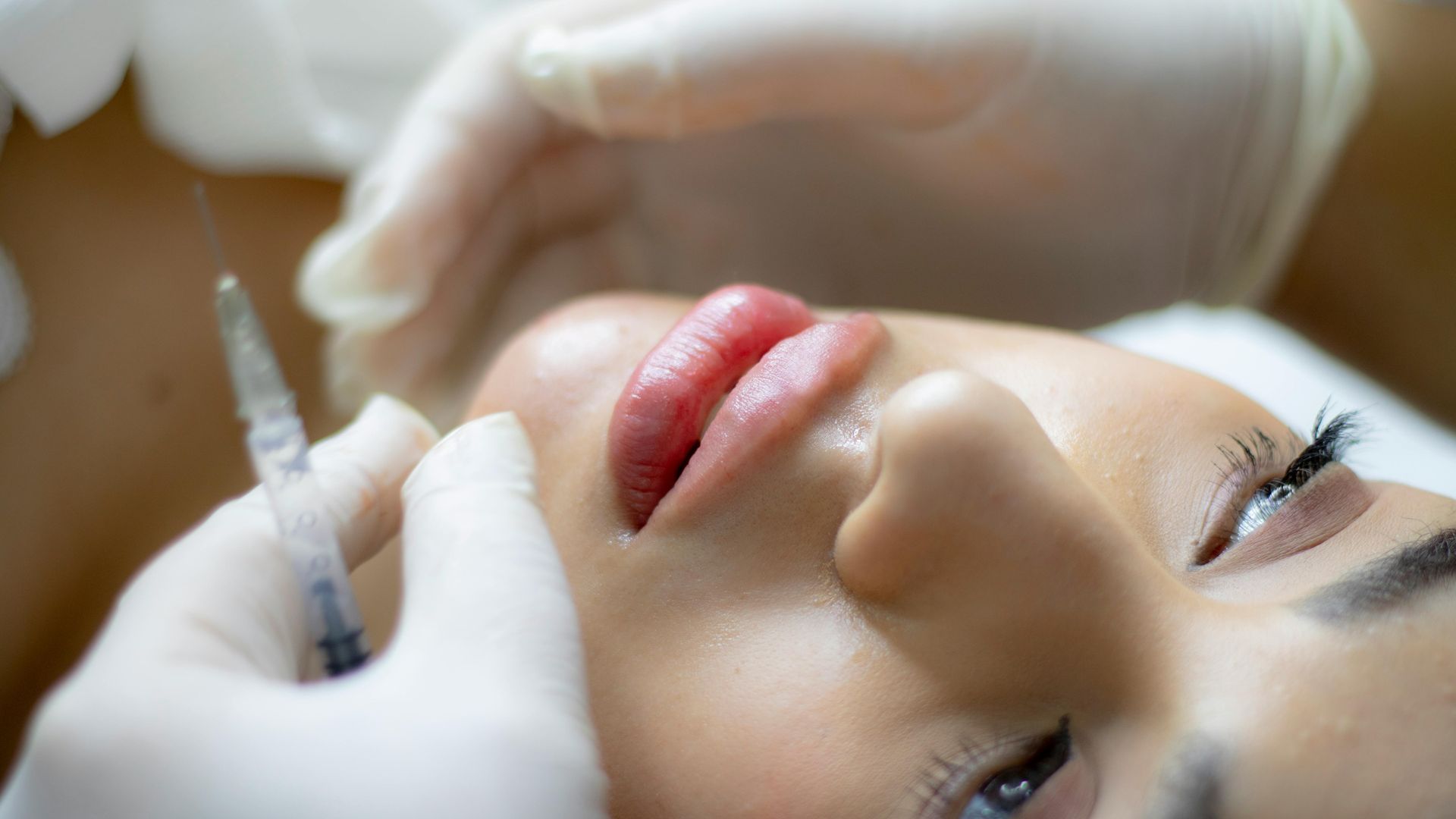
Hyaluronic acid filler is the most widely used non-surgical treatment for nasolabial folds and the one our injectors reach for most often. Hyaluronic acid is a sugar molecule your skin already produces to hold moisture. In filler form it is cross-linked into a smooth gel that stays in place for months and physically supports the tissue above it. Our dermal fillers in Dearborn come from the Juvéderm and Restylane families, both FDA-approved and both studied extensively in this area of the face.
Filler can address smile lines in two ways, and skilled injectors often combine them. The first places a soft, flexible gel directly beneath the fold to lift the crease from underneath. The second treats the cause higher up by restoring volume over the cheekbone, which lifts the tissue that has been sagging onto the fold. Cheek support frequently softens a smile line more naturally than filling the line alone, and it usually means less product is needed in the fold itself.
The clinical evidence is strong. In a double-blind randomized trial published in the Journal of Drugs in Dermatology, investigators rated 87.3% of patients as responders with both Juvéderm Ultra and Restylane, meaning at least a one-grade improvement in fold severity six months after treatment. Much of the change is visible the same day, and the final look settles once minor swelling resolves over roughly two weeks.
Smile line filler typically lasts six to twelve months, and cheek volumizers often hold longer because that area moves less during speech and expression. Our guide on how long dermal fillers last breaks the timeline down by product and treatment area.
Is Sculptra a good option for smile lines?
Sculptra is a poly-L-lactic acid injectable that stimulates your skin to rebuild its own collagen. Once injected, the microparticles prompt fibroblasts in the deeper skin to produce new collagen over the following weeks and months, gradually restoring structure along the fold and across the midface. Sculptra has held FDA approval for correcting nasolabial folds and other facial wrinkles since 2009, and it suits patients whose smile lines come with broader facial thinning.
The trade-off is patience. Sculptra in Dearborn is given as a short series of sessions spaced several weeks apart, and the improvement builds over a few months. In return, results can last up to two years, and the change looks natural since it comes from collagen your own body made. Some patients pair a small amount of hyaluronic acid filler for an immediate lift with Sculptra as the long-term foundation.
Can RF microneedling and laser treatments help?
Energy-based treatments improve the skin along the fold, which makes them a strong partner to injectables. When a smile line has been present for years, the skin directly over it often thins and develops its own fine creases. Filler will lift the fold, while the surface may still look lined until the skin itself is strengthened.
Exion RF microneedling in Dearborn pairs fine needles with radiofrequency energy delivered beneath the surface, heating the deeper layers of the skin to trigger collagen remodeling and tightening. It works well for patients with mild folds and early laxity who want firmer skin through the lower face. Traditional microneedling in Dearborn offers a gentler version of the same collagen response and can be combined with cosmetic PRF, which uses growth factors concentrated from your own blood to support healing and skin quality.
For deeply etched lines and crepey texture around the mouth, laser resurfacing does the most visible work. Helix CO2 laser resurfacing in Dearborn removes damaged surface layers and drives substantial new collagen, with about a week of social downtime. For patients who cannot step away for that long, MOXI laser resurfacing offers a lighter, non-ablative option delivered in a series with minimal recovery. Our guide to skin resurfacing goes deeper on how these approaches compare.
Does Botox work on smile lines?
Botox plays a limited supporting role for this concern. Smile lines are primarily a volume issue, and the muscles that form the fold are the same ones that lift your lip into a smile, so relaxing them heavily would flatten your expression. In select cases an experienced injector may place a very small dose in the muscle beside the nose to soften the upper part of a deep fold or to reduce a gummy smile.
Where wrinkle relaxers shine is the upper face. Botox in Dearborn smooths crow's feet and forehead lines, which often appear in the same years as smile lines, and treating both areas together makes the whole face look more rested. Our comparison of dermal fillers vs Botox explains why the two work on different kinds of lines.
How do the main treatment options compare?
Each option works on a different layer of the problem, which is why the table below is best read as a menu for building a plan.
| Treatment | Best for | When results show | How long it lasts | Downtime |
|---|---|---|---|---|
| Hyaluronic acid filler | Moderate folds and cheek volume loss | Same day, settled by about two weeks | 6 to 12 months in the fold, often longer in the cheek | Minimal, with possible swelling or bruising for a few days |
| Sculptra | Deeper folds with broader midface thinning | Gradually over two to three months | Up to two years | Minimal, with brief swelling after each session |
| Exion RF microneedling | Mild folds and early skin laxity | Gradually as collagen builds over several months | Long-lasting with periodic maintenance | One to two days of redness |
| Helix CO2 laser | Etched lines and crepey skin around the mouth | After healing, continuing to improve for months | Several years with good sun protection | About one week |
| MOXI laser | Fine surface lines and uneven texture | After a series of sessions | Maintained with periodic sessions | One to two days of mild redness |
Injectables work on volume and support, while devices work on skin quality. Folds caused mostly by cheek deflation respond best to the first group, and long-standing folds with thin, lined skin usually need something from both.
Which treatment is right for your smile lines?
Severity and cause matter more than any single product. This is roughly how our injectors approach it in practice:
- Lines that show mainly when you smile. Skin-strengthening treatments such as Exion RF or MOXI, together with daily sunscreen and a retinoid, are often enough to keep early lines from setting in.
- Moderate folds that linger at rest. Hyaluronic acid filler in the fold, often combined with cheek support, usually gives the most noticeable improvement from a single visit.
- Deep folds with midface thinning. Cheek support with filler, followed by Sculptra to rebuild collagen over time, tends to produce the most natural result.
- Etched lines in thin, creased skin. Filler to lift the fold combined with CO2 laser resurfacing to smooth the surface gives the most complete correction.
What we tell our patients: The smile line is rarely the whole story. Before we treat the fold, we look at the cheek above it and watch how your face moves when you talk and laugh. Very often the most natural result comes from placing product somewhere other than the line you pointed to in the mirror.
What can you do at home to slow smile lines?
Home care works best as prevention and as maintenance between treatments. Daily broad-spectrum sunscreen protects the collagen that keeps skin along the fold thick and resilient, and it is the habit with the strongest evidence behind it. A retinoid used consistently at night supports collagen production and improves fine surface lines over several months. Medical-grade lines such as skinbetter science and Alastin, both available at our offices, are formulated for this kind of long-term skin support.
Stable body weight helps preserve midface volume, and quitting smoking slows collagen breakdown noticeably. Facial exercises are popular online, although the evidence for them is thin, and repeatedly working the muscles that form the fold does little for a crease caused by volume loss.
What is recovery like after smile line treatment?
Filler for smile lines takes about 30 minutes, and most patients return to normal activities the same day. Mild swelling and occasional bruising at the injection points usually fade within a few days. We ask patients to skip strenuous exercise and alcohol for 24 to 48 hours, and our before and aftercare guide covers the full instructions. Patients who feel anxious about needles can use PRO-NOX pain management, a patient-controlled nitrous oxide option that takes the edge off without sedation.
Sculptra and RF microneedling involve a day or two of redness and mild swelling, while CO2 laser resurfacing requires about a week of healing before the skin looks presentable. Maintenance follows the treatment you choose. Filler is typically refreshed once or twice a year, and Sculptra and energy-based results are maintained with occasional touch-up sessions. Our flexible payment options make a steady maintenance schedule easier to plan.
Every treatment plan at SKIN MD is built by a medical team led by Dr. James Bazzi, MD. You can read more about the experience behind our injectors before you book.
Ready to soften your smile lines? Schedule a consultation at our Dearborn or Northville office, or call us at 248-662-5544. We will look at your whole face and build a plan around what is actually causing the fold.
Frequently asked questions
Are smile line treatments permanent?
Non-surgical results last from several months to a couple of years, depending on the treatment. Hyaluronic acid filler usually lasts six to twelve months in this area, and Sculptra can hold for up to two years. Collagen built through RF microneedling or laser resurfacing persists while natural aging continues around it. Most patients maintain their results with periodic touch-ups.
How much filler do smile lines need?
Many patients with moderate folds need about one syringe to treat both sides. Plans that include cheek support usually call for more product overall, though often less in the fold itself. Your injector will give you a specific estimate during your consultation.
Will filler in my smile lines look obvious?
Well-placed filler looks like a rested version of your face. Overfilled smile lines are usually the result of treating the fold in isolation or using too much product, which is why we start conservatively and address the cheek when it is the underlying cause.
At what age should I start treating smile lines?
The right time is when the fold starts to linger at rest and bothers you. For many people that happens in their mid-thirties to forties. Starting earlier with skin-quality treatments and sun protection can delay the point at which filler becomes necessary.
Can I treat smile lines and marionette lines in the same visit?
Yes. Smile lines and marionette lines share many of the same causes, and treating them together usually produces a more balanced lower face. Your injector will plan product placement for both areas in one session.
References
Wu, Y., Xu, J., Jia, Y., & Murphy, D. K. (2016). Safety and effectiveness of hyaluronic acid injectable gel in correcting moderate nasolabial folds in Chinese subjects. Journal of Drugs in Dermatology, 15(1), 70-76. pubmed.ncbi.nlm.nih.gov/26741384
Zufferey, J. (1992). Anatomic variations of the nasolabial fold. Plastic and Reconstructive Surgery, 89(2), 225-231. pubmed.ncbi.nlm.nih.gov/1732888
American Society of Plastic Surgeons. Dermal fillers.
plasticsurgery.org/cosmetic-procedures/dermal-fillers